Publications and Docs
Journal Papers
Conference Papers
Technical Reports
PresentationsSoftware
Libmac
Libwsec (coming)
WINLAB Team
Wade Trappe
Wenyuan Xu
Panduran Kamat
Kishore
Ramchandran
Princeton Team
Hisashi Kobayashi
Yannis Avramopoulos
Qiang Huang
|
|
The proposed testbed provides an ideal environment for
exploring different security mechanisms for various wireless scenarios.
This experimental work package will focus on two wireless environments for
performing security experiments. First, we shall examine the problem of
securing ad hoc networks, and develop a suite of secure routing protocols,
authentication protocols, and tools for studying distributed denial of
service (DDoS) attacks. Second, we will examine the task of providing
confidentiality to multicast applications deployed on a UMTS 3G network.
As part of the testbed development, we will create reusable software
modules for use on both tiers of the testbed. The testbed will then be
used to learn the shortcomings of different approaches, allowing us to
improve our protocols, and ultimately validate a suite of protocols for
trusted and assured services for future wireless networks.
-
Secure routing for ad hoc
networks: Adversaries that capture network
nodes may disrupt the network’s routing functionality. To prevent such
attacks, secure routing protocols have been proposed, some of which are
for ad hoc networks. We will investigate “Byzantine-robust” routing
protocols for the ad hoc network environment. A second type of protocols
we will investigate is “guaranteed delivery” flooding protocols that use
message authentication codes (MACs). We plan to reduce the size of the
authentication tag, design/implement a secure “topology discovery”
protocol based on the MAC based protocols, and empirically validate
these protocols.
-
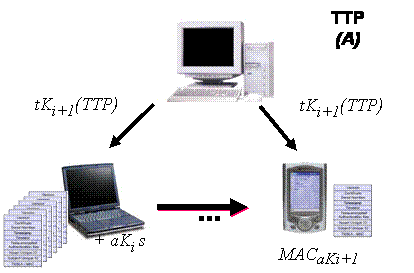
Authentication in Ad
hoc Networks:
A critical hurdle
that prevents the use of public key certificates for authentication in
ad hoc networks is the computational complexity of digital signature
algorithms. We propose to develop and evaluate a lightweight alternative
to public key certificates for ad hoc networks that use delayed key
disclosure, such as provided by TESLA.
-
Characterization and Prevention of DDoS attacks:
Distributed denial-of-service (DDoS) attacks pose a significant threat
to future wireless networks. A promising approach for identifying a DDoS
attack in ad hoc networks is to use a statistical anomaly detection
method based on a hidden semi-Markov model (HSMM). We propose to
develop a DDoS detection algorithm for wireless networks, and build an
admission control strategy to defend against DDoS.
- Securing
Multicast Applications on Wireless Networks:
Conventional
multicast key management schemes are not well suited for 3G group
applications since multicast networking functionality is not employed
throughout the 3G network. Therefore, we propose to develop key
management schemes for the broadcast-multicast service center that are
optimized for deployment on the proposed 3G multicast architectures. Our
approach will be based on prior experience with developing multicast key
management schemes for cellular systems with full multicast
functionality. All 3G experiments will be performed on the Field Trial
Network.
|